The “other side”
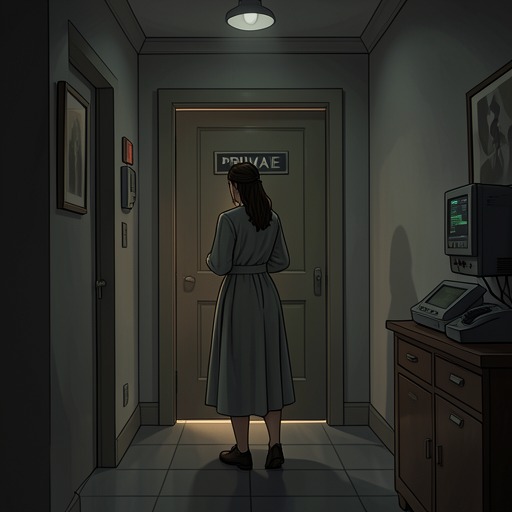
Other PeopleThe “other side” is a recurring image of relational separation in Mary Lamb’s life. It marks moments when apparent solidarity gives way, when a protector must let her go, or when someone remains nearby yet cannot truly meet her. Rather than naming one fixed place, the phrase turns changing degrees of closeness and abandonment into a boundary Mary repeatedly finds herself facing.
A boundary made visible
In the encounter with Sharon, the phrase first gives a sharp name to a reversal. Sharon has been confiding in Mary about her sexual relationships, her inability to stop despite the risks, and her childhood thought of becoming a nun. The intimacy of that disclosure might suggest trust, but the arrival of Jock and Trev changes the scene. Mary immediately understands that Sharon is no longer on her side, and the narration adds the more unsettling qualification that perhaps she never was. Sharon has brought Mary only as far as she intends to; beyond that point, Mary is alone.
The image does not depend on a physical wall. It makes a social realignment legible: Sharon’s presence has not guaranteed loyalty, and the two men’s arrival makes the cost of that uncertainty immediate. Jock’s size and stillness are difficult for Mary to assess, while Trev presses closer and asks where Sharon got her. The men are described as alarming in different ways, and their eyes are compared to Sharon’s. Against this gathering threat, the boundary between being accompanied and being exposed becomes the scene’s decisive fact.
Sharon’s second withdrawal
The phrase returns after violence has interrupted the encounter. Sharon lies on the floor and tells Mary to go on; the narration again insists that she is gone and on the other side. The repetition does not undo the first reversal but confirms it under altered circumstances. Sharon is now physically present, yet she cannot restore the companionship Mary had hoped for. Her brief instruction leaves Mary to move on without her, making separation both a statement of allegiance and a practical condition of the scene.
The repeated wording also resists a simple account of Sharon as either ally or enemy. Before the men arrive, she speaks openly and emotionally; when they appear, Mary recognizes that this apparent closeness offers no reliable protection. Later, Sharon’s words direct Mary onward, but the narration still describes her as gone. The motif holds those details together without resolving them into a stable relationship: a person can share confidences, fail to stand beside Mary, and remain part of the moment in which Mary has to leave.
Departure and the cost of letting go
The boundary takes a quieter form when Gavin Botham helps Mary prepare to leave. Together they pack her suitcase, putting into it Sharon’s clothes and some of Mrs Botham’s clothes that have more or less become Mary’s. Mary would like to take books but does not risk asking. Gavin explains how to reach the hostel by Underground, gives her four pounds, all he can spare, and embraces her tightly at the front door. Even in that embrace, Mary can tell that he is already on the other side; she breaks away and hurries down the steps.
This departure complicates the motif. Gavin has helped her materially and continues to show concern about her safety, so his being on the other side need not mean hostility or indifference. The separation comes with care: shared packing, directions, money, and an embrace. Yet those gestures cannot prevent the parting. Mary does not take the Underground route Gavin explains. She walks, and the suitcase that feels light at first grows steadily heavier as the day closes in. Holding up the small sheet of paper with the address, she asks strangers for directions; some cannot help, some cannot explain, and some move on without answering. The journey makes the emotional division concrete as a distance she must cross largely by herself.
A look that closes conversation
With Trudy, the separation is compressed into a look. Mary might have said something else, but Trudy’s expression tells her that Trudy is already on the other side. No spoken explanation is needed in the moment: Mary reads the look as the end of an opening for further speech. Honey accompanies her upstairs, and Mary says goodbye to Mrs Pilkington and gives a fixed address. Russ and Alan wait uneasily in the hall, neither liking the place. The surrounding farewells and practical arrangements give the silent exchange its weight: once Trudy has withdrawn, Mary continues through the steps required to leave.
Nearness without contact
The image also illuminates Alan’s persistent presence around Mary at the squat. He hovers on the staircase in the mornings, waits for her at work, stands outside the cloakroom at the end of the day, and appears again on the stairs at night to wish her goodnight. The narration likens him to a phantom waiting on the wrong side of the doors of the living. His repeated proximity does not bring him into genuine contact with Mary; he watches and waits, while she feels his eyes and his presence following her through shared spaces.
That contrast becomes clearer beside Russ’s behavior. Alan never does or says anything, while Russ touches Mary, kisses her, and talks about plans for the two of them. Even Mr Garcia and Antonio are described as more demonstrative than Alan. The motif therefore names more than outright abandonment: it also catches the distance between wanting to be near someone and being able to establish a mutual relationship. Across Sharon’s reversal, Gavin’s painful but caring farewell, Trudy’s look, and Alan’s watchful waiting, the other side is a shifting threshold. It separates Mary from support, but it can also separate silent longing from reciprocal intimacy.